

What actually happens during an emergency HVAC repair visit
Discover emergency hvac repair what to expect: safety steps, technician process, timelines & prevention tips for NW Washington homes.
What Emergency HVAC Repair Actually Looks Like — And What to Expect
Emergency HVAC repair what to expect is one of the most stressful unknowns a homeowner can face — especially when it's the middle of the night, temperatures outside are dropping below freezing, and your furnace just went silent.
Here's a quick overview so you know exactly what happens:
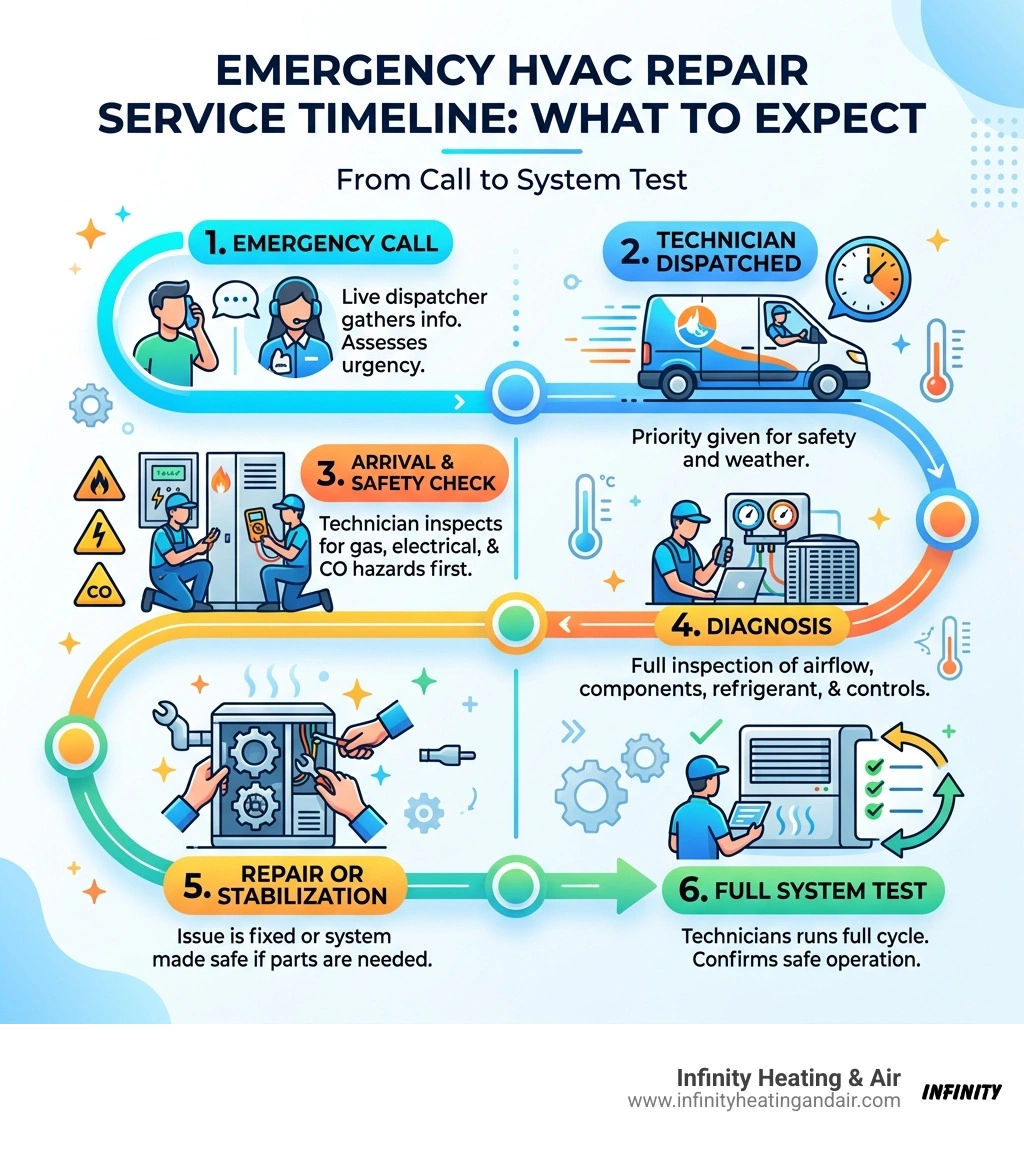
When you call for emergency HVAC service, here's what typically unfolds:
- You call — A live dispatcher gathers your symptoms, system details, and assesses urgency
- A technician is dispatched — Priority is given based on safety risk and weather conditions
- Arrival and safety check — The tech checks for gas leaks, electrical hazards, and carbon monoxide first
- Diagnosis — Airflow, electrical components, refrigerant levels, and safety controls are inspected
- Repair or stabilization — The issue is fixed on the spot, or the system is safely stabilized if parts must be ordered
- Full system test — The technician runs a complete cycle before leaving to confirm safe operation
Most emergency repairs are completed within 1 to 3 hours of the technician arriving.
It's worth knowing that 70% of homeowners experience an HVAC breakdown during peak seasons — exactly when systems are working hardest and getting help feels most urgent. And about 40% of those emergencies trace back to something as simple as a thermostat malfunction or a tripped breaker.
That means not every HVAC crisis is as catastrophic as it feels at 2 AM — but some genuinely are, and knowing the difference matters.
This guide walks you through the entire process, from identifying a true emergency to what the technician does step by step, so you're never caught off guard.
Identifying a True HVAC Emergency in Northwest Washington
Living in Northwest Washington, we know that weather can turn on a dime. When your heating or cooling fails in April 2026, the first thing you need to determine is: "Is this a crisis or an inconvenience?" A true HVAC emergency is any situation that threatens the safety of your family, the integrity of your property, or the health of those living in the home.
Safety hazards are the most critical indicators. If you smell the "rotten egg" scent of mercaptan (the additive in natural gas), see electrical sparks, or notice a thick burning odor, you are facing a high-priority emergency. These aren't just mechanical failures; they are fire and health risks. Furthermore, a total system failure during a hard freeze can lead to burst pipes, which can cause tens of thousands of dollars in water damage. If you're in the middle of a cold snap, checking our Emergency Heating Repair Tacoma Guide can help you decide if it's time to call the pros.
When is no heat or AC considered an emergency hvac repair what to expect?
In the Pacific Northwest, "no heat" is almost always an emergency during winter. If the outdoor temperature is below freezing, your home can lose heat rapidly. This poses a significant health risk to vulnerable residents, such as infants, the elderly, or those with chronic illnesses. Additionally, if your indoor temperature drops below 50°F, your plumbing is at risk.
While our summers are usually mild, heat waves are becoming more frequent. If outdoor temperatures soar above 90°F and your AC fails, it can lead to heat exhaustion indoors, especially in homes with poor ventilation. For those in Pierce County, our Emergency Heater Not Working Help Lakewood resource offers specific insights into managing these sudden failures.
Recognizing critical system red flags
Sometimes the system is still running, but it’s screaming for help. You should call for emergency service if you notice:
- Loud banging or screeching: This often indicates a mechanical failure, like a detached blower wheel or a dying motor.
- Pooling water: Large amounts of water around your furnace or indoor AC unit can indicate a clogged condensate line or a cracked heat exchanger.
- Ice buildup: If your outdoor unit is encased in ice during the summer, your coils are frozen, and continuing to run the system could destroy the compressor.
If you're dealing with these issues in South Sound, consult our Emergency Heat Pump Repair Tacoma WA guide for immediate advice.
Immediate Safety Steps and Troubleshooting Before the Technician Arrives
Before you pick up the phone, there are a few things you can do to stay safe and potentially solve the problem yourself. If you smell gas or smoke, shut the system down immediately at the thermostat and the circuit breaker. If it's a gas leak, evacuate the house and call the utility company from outside.
For non-life-threatening issues, a little "triage" goes a long way. Many homeowners are surprised to find that a simple fix can restore comfort. We’ve compiled Tacoma Emergency Heating Maintenance Tips to help you navigate these first few minutes of a breakdown.
Basic checks to perform at home
Statistics show that about 40% of HVAC emergencies actually stem from simple thermostat malfunctions or power issues. Before calling for emergency hvac repair what to expect, check these four things:
- The Thermostat: Are the batteries dead? Is it set to the correct mode (Heat/Cool)?
- Circuit Breakers: Check your electrical panel. If the breaker for the HVAC has tripped, reset it once. If it trips again immediately, stop—this indicates an electrical fault.
- The Furnace Switch: Most furnaces have a switch nearby that looks like a standard light switch. It’s easy to bump this off accidentally while reaching for storage.
- Air Filters: A severely clogged filter can cause the system to overheat and shut down as a safety precaution.
For a deeper dive into these DIY steps, see our 24hr Heater Not Working Olympia WA Guide.
Preparing your home for the service call
To ensure the technician can work quickly, take a moment to prepare the workspace. Clear a path to both the indoor unit (in the attic, crawlspace, or closet) and the outdoor condenser. Secure your pets in a separate room so they aren't stressed by the noise or the technician's movement.
It is also incredibly helpful to have your system's model number and a brief history of the problem ready. Did it make a noise before it stopped? Has it been short-cycling for weeks? This information helps us perform a faster diagnosis. Our Emergency Heating Maintenance Guide Puyallup WA provides a great checklist for this preparation.
The Step-by-Step Process: What Happens During the Service Call
When you call us for Emergency HVAC Service, our dispatch process kicks into high gear. We prioritize calls based on safety risks and household vulnerability. Once a technician is on the way, you’ll receive an arrival estimate.
The visit starts with an initial interview. The technician will ask you about the symptoms you noticed. Then, they move into a visual inspection and technical diagnostics. This isn't just a "look-see"—it involves using specialized meters to check electrical draw, refrigerant pressures, and safety control functionality.
Emergency HVAC repair what to expect during the technician's visit
During the diagnostic phase, we look at several key areas:
- Airflow: We check for blocked ducts or failing blower motors.
- Electrical Components: We test capacitors (the most common part to fail) and contactors.
- Safety Controls: We ensure the limit switches and flame sensors are operating correctly to prevent fires or gas leaks.
- Refrigerant Levels: For heat pumps and ACs, we check for leaks that might be causing the system to freeze up.
If you’re using a heat pump in Pierce County, you can learn more about this specific diagnostic path in our Emergency Heat Pump Repair Puyallup Guide.
Understanding the diagnosis and repair plan
We believe in using plain language. Once the technician finds the problem, they will explain what failed, why it failed, and what the options are for fixing it. Sometimes, the fix is straightforward—like replacing a cracked ignitor (which typically lasts 5-7 years). Other times, it might be a more complex issue with the compressor.
In every case, our goal is system stabilization. We want to get your home back to a safe temperature as quickly as possible. For residents in Graham, our Emergency Heat Pump Repair Graham WA Guide explains how we handle these diagnostic conversations.
How long does an emergency hvac repair what to expect take to complete?
The timeline for a repair depends heavily on the complexity of the issue.
| Repair Type | Typical Duration |
|---|---|
| Simple (Capacitor, Fuse, Thermostat) | 30 - 60 Minutes |
| Moderate (Ignitor, Flame Sensor, Clear Drain Line) | 1 - 2 Hours |
| Complex (Blower Motor, Control Board) | 2 - 4 Hours |
| Major (Evaporator Coil, Compressor) | 4+ Hours / May require second visit |
Most emergency calls are resolved within a few hours. However, weather impacts (like a technician needing to clear snow to reach an outdoor unit) or part availability can extend this. If a major installation is required, our Emergency Heating Installation Lacey WA team works to get you on the schedule immediately.
When a temporary fix is necessary
Sometimes, a permanent repair isn't possible at 2 AM. If a specific, rare part is needed that isn't on our fully-stocked trucks, we will implement a temporary fix to stabilize the system. This might mean bypassing a non-essential sensor (safely) or providing space heaters to keep your pipes from freezing until the part arrives the next morning.
The priority is always safety verification. We will never leave a system running if it poses a risk of carbon monoxide or fire. If your heat pump is struggling, our Emergency Heat Pump Not Heating Tacoma Guide explains how we bridge the gap between a breakdown and a final fix.
Final system testing and quality assurance
Before we leave, we don't just "flip the switch." We perform a full system test. This includes:
- Cycling Check: Letting the system run through a full heating or cooling cycle.
- Thermostat Calibration: Ensuring the temperature you set is the temperature the system is actually delivering.
- Airflow Verification: Checking that all vents are blowing at the correct temperature.
- Cleanup: We respect your home and will ensure the workspace is as clean as we found it.
For more on what we check during these final steps, see the Emergency Heating Repair Guide Puyallup WA.
Preventing Future Breakdowns with Proactive Maintenance
The best emergency is the one that never happens. Statistics show that homeowners who invest in regular maintenance are 50% less likely to face an emergency breakdown. A well-maintained system can last 15-20 years, whereas a neglected one may fail in as little as 8-10 years.
Annual tune-ups allow us to catch small issues—like a fraying belt or a weakening capacitor—before they turn into a midnight crisis. Plus, a clean system operates 15-20% more efficiently, saving you money on utility bills. Residents in Graham can find more prevention tips in our Emergency Heating Maintenance Graham WA Guide.
Benefits of priority service memberships
Many of our customers choose maintenance plans for the peace of mind they provide. These memberships often include:
- Priority Scheduling: When everyone's AC goes out on the same 95-degree day, members move to the front of the line.
- Early Detection: Two inspections per year (one for heat, one for air) catch 90% of common failure points.
- Extended Lifespan: Keeping the system clean reduces the strain on the motor and compressor.
Check out our Emergency Heat Pump Maintenance Tacoma Tips to see how regular care keeps your system running through the toughest Northwest winters.
Frequently Asked Questions about Emergency HVAC Services
What should I do if I smell gas or notice burning odors?
If you smell gas (rotten eggs) or see smoke, evacuate immediately. Do not flip any light switches or use your phone inside the house, as a spark could trigger an explosion. Call 911 or your gas utility from a neighbor's house, then call us for a safety inspection and repair.
Is a total system failure always considered an emergency?
In extreme weather (below 35°F or above 90°F), yes. It is also an emergency if you have vulnerable residents in the home. If the weather is mild and there are no safety risks (like gas or fire), you may be able to wait for a standard appointment to avoid after-hours fees.
How do I choose a reliable 24/7 HVAC provider in Northwest Washington?
Look for a company that offers true 24/7 live dispatch—not just an answering machine. Ensure they are licensed, bonded, and have experience with the specific brands used in our region. Reliability and transparency in their diagnostic process are key.
Conclusion
At Infinity Heating & Air, we understand that an HVAC failure is more than an inconvenience—it’s a disruption to your family’s safety and comfort. Whether you’re in Tacoma, Olympia, or Puyallup, our team is dedicated to crafting "endless comfort" through reliable, expert service.
Don't wait in the cold or suffer through a heat wave. If your system is acting up, contact us for Emergency HVAC Service today. We’re here to help you through the crisis and keep your home safe for years to come.
Written & reviewed by the Infinity Heating & Air team — licensed WA HVAC contractor (INFINHA841B8). Family-owned in Graham, answering 24/7 across the South Sound.
Choose Infinity & enjoy endless comfort.
Your perfect home environment awaits — call (253) 740-5135 or schedule service online and our team will take it from there.
Open 24/7 · 100% Satisfaction Guaranteed · Graham, WA
